
Ahead of completion of three years of the National Democratic Alliance, the Congress young brigade alleged that the government has failed on various counts including on issues like dealing with Pakistan, Kashmir policy, internal security, women safety and rising cases of rapes, atrocities on Dalits, high petrol and diesel prices, besides generation of jobs.
The BJP is still short of the halfway mark of 123 in the 245-member House, but can now muster a 'working' majority with help of allies, friendly parties, some Independents and nominated members.
Modi's NDA is good enough to give a psychological boost to the once 'untouchable' BJP and Modi but if the NDA doesn't get a majority on its own, then walking the last mile will be the greatest challenge of this election for Modi, says Sheela Bhatt/Rediff.com

The DMK has been alleging that the AIADMK government was being controlled by the BJP government at the Centre.

Defying prohibitory orders, protests were held in Delhi, Bengaluru, Hyderabad and several other cities. Protesters, mostly students and activists, were detained on a large scale in national capital and other places.
Senior advocate A M Singhvi, appearing for Dev, said that the poll panel has passed 'unreasoned' orders while dismissing complaints of MCC violations against Modi and Shah and moreover, there have been reports of dissent by one of the election commissioners in passing some of the decisions.
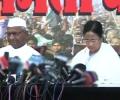
Kisan Baburao Hazare is supporting Mamata Banerjee's Trinamool Congress and attempts are afoot to form an alternative Third Front. Will these alliances really work, asks Bharat Bhushan.

She said there were attempts to communalise the guru's teachings and this amounts to 'betraying' him.

'I am very sure that Rajnikanth, a patriot and a spiritual person, will not do this movie which is about a tyrant, killer and murderer,' BJP leader H Raja tells Syed Firdaus Ashraf/Rediff.com

'Mere 'literacy' is not the same thing as 'education', which involves conceding that others have rights, and that one of those prerogatives is a woman's right to dignity. In 2012, the Kerala police registered 1,474 cases of rape, of which 455 victims were children,' says T V R Shenoy.

Trupti Desai's fight earned women the right to enter the inner sanctums of the Shani Shingnapur Temple, the Trimbakeshwar Shiva Temple and the Haji Ali Dargah. Her next target is Sabarimala in Kerala. Aditi Phadnis reports.

'The right conferred by Article 32 has been considered as a part of the 'basic structure of the Constitution', and thus cannot be taken away by anybody, not even by amending the Constitution.'

'If the Kasturirangan Committee report is implemented, the mining and quarrying lobbies will flourish... It will be disastrous for the environment... There will be water shortage, there will be pollution. Finally, farmers will have to quit the area.' Dr V S Vijayan, a member of the Gadgil Committee, points out how the Kasturirangan Committee report will hit both people living in the Western Ghats as well as the plains.

A bench headed by Chief Justice Ranjan Gogoi said it would hear the petition on Tuesday.
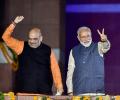
Modi and Shah's next focus will be South India, and the Maharashtra and Jharkhand assembly elections. Shah is unlikely to abdicate control over the party even after he joins the government. Modi and Shah both know only too well that the party makes the government, and not the other way round.

Prime Minister Modi described the DMK chief as a prolific thinker and a deep-rooted mass leader who stood for regional aspiration and national progress.

RJD chief Lalu Prasad and other leaders claimed the countdown for the ouster of the BJP and its allies from power in the 2019 Lok Sabha polls had begun.
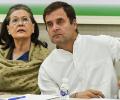
It would be best that Rahul remains party chief, but at the same time, Rahul's own wishes must also be respected, Aiyar said.
.jpg)
Union Minister and senior Congress leader Veerappa Moily on Saturday claimed that the Bharatiya Janata Party was turning to be a friendless party after it named Gujarat Chief Minister Narendra Modi, who lacked a pan-Indian acceptance, as chairman of its National Campaign Committee.

Rediff.com's Rajesh Karkera shares his impressions from the Kochi-Muziris Biennale, India's landmark artistic extravaganza.

Complaints of electronic voting machine malfunctioning poured in from several booths on Tuesday during the third and largest phase of Lok Sabha polls which saw voters turning out in large numbers to cast their vote in 116 seats, including all constituencies of Gujarat and Kerala.

'Presidents may come and go, but America will go on forever,' an American business leader tells Ambassador T P Sreenivasan in New York.

During the meeting, the parties also decided to unitedly move forward in fielding a joint candidate for the post of deputy chairman of Rajya Sabha, which fell vacant after the retirement of P J Kurien on July 1.

'What the Congress needs now is an ideological and social contrast to the BJP.' 'The Congress stable of princelings cannot do it,' argues Mohan Guruswamy.
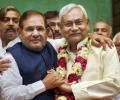
'Sharad Yadav was deeply hurt by Nitish Kumar's decision, taken without consulting the senior party leaders at a time when opposition unity was to be strengthened against the BJP. He felt ignored and is likely to take a final stand soon.'

'Another rejection of mediation between India and Pakistan will leave Mr Trump disappointed.' 'In that case, he is likely to point out the war-like situation on the border and press for direct talks which have been stalled on account of continuing terrorism from Pakistan,' notes Ambassador T P Sreenivasan.

Pulling no punches in her attack against the Bharatiya Janata Party for allegedly pursuing 'political vendetta' against the Trinamool Congress, West Bengal Chief Minister Mamata Banerjee on Thursday charged that the Central Bureau of Investigation was being used as a 'political tool' by the National Democratic Alliance government and was functioning as 'a department of the Prime Minister's Office'.

Protests were held in many cities across the country. So far, no one has been arrested for the attack on students and teachers at JNU even as clamour for resignation of the V-C grew.
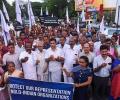
'The nominations were not meant to last permanently, but depended on the government of the day.' 'There was no question of revoking it during Congress, Janata Dal or even Vajpayee's NDA rule.' 'But Modi is different.'
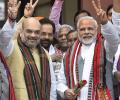
Having focussed excessively on the Congress, and continuously drawing a Modi-Rahul parallel as if it were the sole selling point, the BJP has lost sight of the regional parties that are seeking to take the centre-stage, says N Sathiya Moorthy.

Prime Minister Narendra Modi gave the vote of thanks to the President's speech on the opening day of the Budget session.
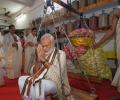
'The return of India to its own civilisational values can never endanger freedoms as pluralism is the bedrock of our culture,' assert Lieutenant General Ashok Joshi (retd) and Colonel Anil A Athale (retd).

Here is a closer look at politicos who have emerged victorious in the electoral contest of five state assemblies.

Jamida K is the first Indian Muslim woman to lead the Friday prayer.
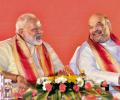
2,470 BJP workers from across the country would spend a year visiting polling booths, while another 1,441 workers would spend six months and 378,000 workers will spend 15 days to reach out to party cadres and ensure better polling management in areas outside their home districts.
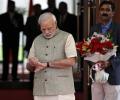
'Non Resident Indians know that India's problems are the combination of many factors over the centuries, including foreign rule, lack of resources and the ever-growing population, among other things. Yet, India has achieved many things and even looks at Mars as a neighbour.'

With the solar panel scam continuing to turn the heat on Kerala's Congress-led United Democratic Front government, telephone call details gathered by investigators showed that several ministers and political leaders had made calls to the prime accused in the case Saritha Nair, apart from getting frequent calls from her.
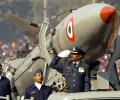
While we have to hiss loudly and do the lunging bit to keep our foes on their toes, that's only a tactical matter. What is the strategic goal? What is the end game? In my opinion, there is only one possible end game: the unwinding of Pakistan into several pieces: Balochistan, Sind, Balawaristan (Gilgit, Baltistan, the rest of PoK), the Pashtun area Khyber Pakhtunwa which will merge with Afghanistan, and the rump Punjab, says Rajeev Srinivasan.

'The Left is dying, but its economic ideology rules, unchallenged.' 'Modi is its newest standard-bearer.' 'Even in today's bitterly polarised politics, if there is one thing on which not just the BJP and Congress, but all other parties agree, it is that socialist economics is the only way to survive,' says Shekhar Gupta.

'He only talks about what concerns our home, like what I have made for lunch or dinner. No politics at home and no controversies too.' 'If I want to know something, I have to update myself from the newspapers or the local people; unfortunately no inside information.' 'He is like a strong fort, which no one can break and get in, not even his wife.'
